
All parents want their children to have fun learning and to learn the skills they will need for success in the future. With the rise in the adoption of innovative teaching methods, however, it can be challenging to navigate the choice of the right approach to learning. Montessori education and experiential learning are some of the discussed methods. They both stimulate children to take part and think independently, but they are very different in the way that children interact with knowledge and the classroom.
Today’s education is about more than just books and tests. Academic excellence is expected alongside nurturing creativity, collaboration, emotional intelligence and critical thinking through school. That is why parents who are looking for schools near dwarka delhi take into account the educational practices of schools before choosing one. Though the Montessori approach has revolutionized early childhood education, experiential learning has become a holistic learning model that helps students for all ages to be ready for real-life issues.
Understanding Montessori Education
The philosophy behind Montessori education is that kids learn best when they are able to move at their own speed. The classroom is planned to promote independence so that students can select activities according to their interests, and the teachers are not considered as a teacher anymore but as a facilitator.
Key characteristics of Montessori learning include:
- Self-directed activities
- Mixed-age classrooms
- Hands-on learning materials
- Minimal disruption in learning.
- Emphasize independence and responsibility
- Each student’s own rate of learning
Many parents regard Montessori education as the best preparation for the preschool and primary years as it allows their children to develop confidence, concentration and problem-solving skills.
What is Experiential Learning?
Experiential learning is based on the principle of “learning by doing. Students are not only engaged in projects, experiments, discussions, field visits, presentations, simulations, and collaborative activities, but they are also actively involved in the learning of concepts that are relevant to real life situations.
The following are some of the key components of experiential learning:
- Project-based learning
- Inquiry-driven classrooms
- Group collaboration
- Practical experiments
- Real-world problem solving
- Reflective learning
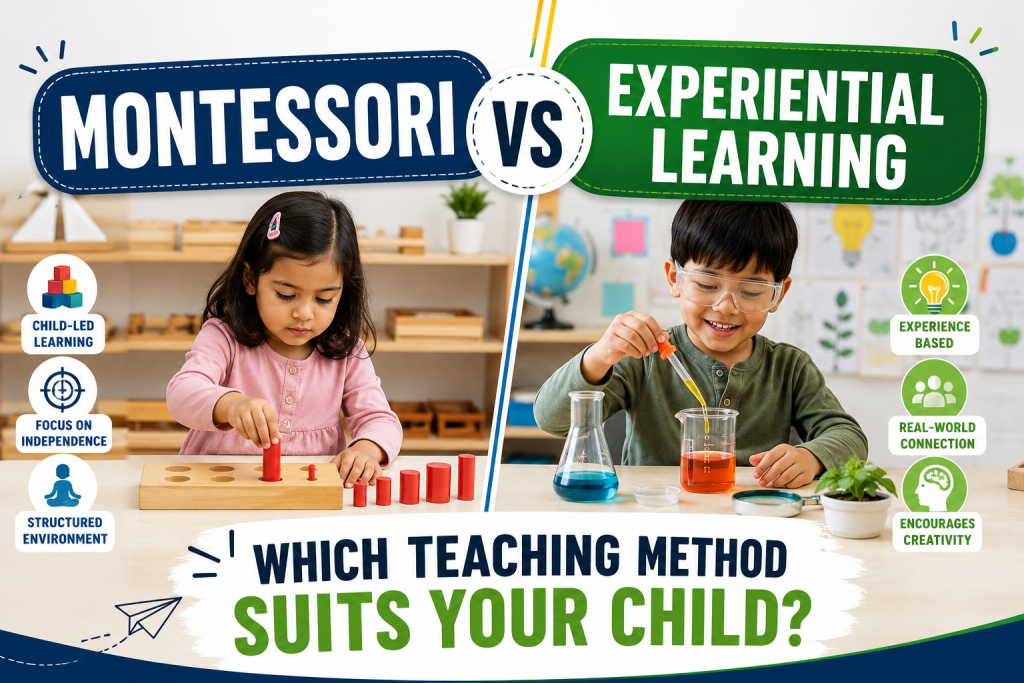
Montessori vs Experiential Learning: Key Differences
Although both approaches encourage active participation, their objectives and implementation vary considerably.
| Montessori Learning | Experiential Learning |
| Child-led exploration | Teacher-guided real-world application |
| Focuses on independent learning | Encourages collaborative learning |
| Uses specialized learning materials | Uses projects, activities, and practical experiences |
| Mostly associated with early childhood | Effective across all school grades |
Many parents consider schools that offer a balanced approach to education, incorporating both theoretical instruction and practical learning, to be the best school in delhi.
Why Experiential Learning is Gaining Popularity
Parents are more aware than ever that grades are not the only factor to consider when determining long-term success. Pupils should also be confident in using their knowledge in new scenarios.
Experiential learning allows students to:
- Relate classroom ideas to real life
- Take advantage of success and failure
- Develop curiosity through exploration
- Develop independent thinking
- Improve classroom engagement
- Strengthen practical understanding
All these benefits have led many schools in the vicinity of dwarka delhi to adopt activity based and project based learning in their learning process.
How parents can select the right approach
All children are unique learners. Some like to investigate on their own, others like to participate in discussions and group activities.
Parents should take into account:
- Their child’s personality
- Learning preferences
- Classroom environment
- Teacher-student interaction
- Opportunities beyond academics
- Find a balance between theory and practice.
- Practice life skills and emotional development.
When looking for the best school in delhi, it is important to consider a school that fosters academic excellence, creativity, confidence, and character development.
The Role of Experiential Learning in Holistic Education
Holistic education equips students for exams and for the real world. Experiential learning promotes intellectual, emotional, physical and social growth at the same time.
Students benefit through:
- Improved confidence in presenting work.
- Enhanced peer working relationships.
- Enhanced problem-solving abilities
- Increased interest in learning
- Stronger leadership skills
- Using theory to inform practice
For parents who are looking into the schools near dwarka delhi, experiential learning provides a balanced educational experience, training children for higher education and future careers.
Why Prudence Schools Focus on Experiential Learning
The purpose of education at Prudence Schools is to enable children to become confident learners, responsible citizens, and future ready. Although it is important to have a basic understanding of these concepts, the school feels that learning occurs when the student is actively involved, questioning, experimenting and reflecting.
Students are encouraged to put classroom knowledge into practice through project-based activities, collaborative learning, STEM initiatives, creative arts, sports, leadership opportunities, and technology enabled classrooms. The learner-centred approach enables all children to be critical thinkers, creative, communicative and resilient.
Parents who want the best school in delhi appreciate this well-balanced educational approach that blends academics with real-life learning experiences. Likewise, families looking for schools near dwarka delhi prioritize a setting that fosters children’s growth, encourages their potential, and equips them with the skills necessary for a successful life.
Frequently Asked Questions
What is the main difference between Montessori and experiential learning?
Montessori education emphasizes self-directed exploration using specially designed learning materials, particularly during early childhood. Experiential learning, on the other hand, focuses on applying knowledge through projects, experiments, collaboration, and real-world experiences across different grade levels, helping students connect academic concepts with practical situations.
Which teaching method is better for early childhood development?
Both methods offer valuable benefits for young learners. Montessori builds independence, concentration, and self-discipline, while experiential learning develops curiosity, communication, and problem-solving through engaging activities. A school that thoughtfully incorporates experiential opportunities alongside strong foundational learning can provide a well-rounded educational experience.
How does experiential learning help children retain knowledge better?
Experiential learning encourages children to actively participate in lessons rather than passively memorize information. Through practical activities, discussions, reflection, and hands-on experiences, students understand concepts more deeply, making it easier to remember and apply their knowledge in different academic and real-life situations.
What are the long-term benefits of experiential learning for school-going children?
Experiential learning helps children develop essential life skills such as critical thinking, creativity, leadership, teamwork, adaptability, and effective communication. These competencies support academic achievement while preparing students for higher education, professional careers, and lifelong learning in an ever-changing world.