
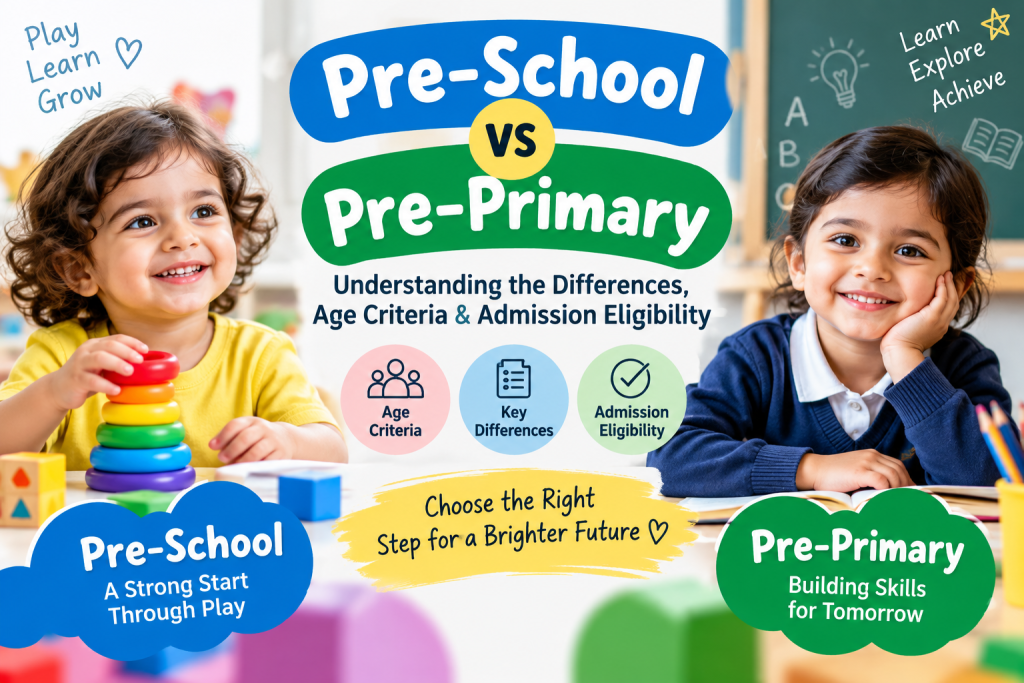

One of the most important decisions a parent will make regarding their child’s education is the selection of the appropriate foundation stage. Some of the terms used in School Admissions in Delhi can cause confusion, like Pre-School, Nursery, Pre-Primary, KG, Lower KG and Upper KG. Knowing the meaning of these stages, how they differ and at what age your child should be can make the admission process much easier.
When parents are looking for the best school in delhi, it’s also crucial to consider the school’s philosophy on the importance of building a strong educational base. Children start to learn communication, social, emotional, motor and problem-solving skills in the early years. Choosing a school that provides a nurturing and enriching environment can provide a solid base for continued learning.
Understanding Pre-School and Pre-Primary
Traditionally, Pre-School or Nursery is the first formal entry into school and Pre-Primary or KG is the next before Class 1. The structure of the foundational stage in Delhi, however, is being brought in line with the National Education Policy (NEP) 2020.
Delhi’s Directorate of Education has given three-year pre-primary education before Class 1 for the academic session 2027-28, with Nursery/Bal Vatika 1 at 3+, Lower KG/Bal Vatika 2 at 4+, and Upper KG/Bal Vatika 3 at 5+. Class 1 is for children 6+ years old. The nomenclature used by individual schools may vary.
Pre-School and Pre-Primary: What’s the difference?
The main difference is the developmental stage and readiness of the child. Pre-School is usually the first step in a child’s education and introduces them to the school building, and as the children progress through the foundation classes they are slowly eased into the more structured academic environment.
Children may concentrate on the following at Pre-School:
- Classroom routines and social interaction
- Basic language development
- Early numeracy, recognition skills
- The development of fine and gross motor skills.
- Learning through play and activities
Age Criteria for Delhi School Admissions
During the School Admissions in Delhi, age eligibility is a crucial aspect as admission forms and necessary documents must align with the relevant age requirements for the academic year.
The Delhi Directorate of Education has provided the following structure for 2027-28:
| Class | Minimum Age | Maximum Age |
| Nursery / Pre-School 1 | 3+ years | Up to 4 years |
| Lower KG / Pre-School 2 | 4+ years | Up to 5 years |
| Upper KG / Pre-School 3 | 5+ years | Up to 6 years |
| Class 1 | 6+ years | Up to 7 years |
The age is determined as at 31 March in the year that admission is applied for. The new structure will be phased in from 2027-28.
How the 100-Point Admission System Works
It is important for parents to understand about a 100-point system when they are looking for the best school in delhi. It usually applies to open-seat admissions requirements of individual private schools without the aid of a central testing program. This may vary from school to school.
For instance, in the published Pre-School criteria of Prudence Ashok Vihar for 2027-28, 100 points are awarded based on neighbourhood, siblings and girl child / first born. The distribution is slightly different for Prudence Dwarka Sector 22, but it still adds up to 100 points.
Parents should therefore:
- Review the school’s admission policy.
- Carefully determine eligibility in the neighbourhood
- Have sibling related documents available.
- Check birth certificate and residence papers
- Check the admission schedule before applying.
The point system is not a measure of eligibility. The school’s selection criteria will be applied only after meeting the age and admission requirements.
Selecting the Appropriate Base School
While making a choice when it comes to School Admissions in Delhi, parents should not just look at infrastructure or academic performance. In the early years, the school’s curriculum should stimulate curiosity, not academic stress.
Look for a school that provides:
- Child-centred teaching practices
- Safe and supportive classrooms
- Space for the expression of ideas and imagination
- The use of sport and physical activities
- Good teacher/parent communication.
- Age-appropriate learning experiences
Prudence Group of Schools is committed to providing families the best school in delhi that provides learning experiences for students to engage in academics, activities, sports and creative pursuits. It also offers its students opportunities like chess, archery, camping, dance, and taekwondo through its schools.
Documents Parents Should Prepare
When documents are missing, the application process can be stressful. It will make the process easier if they are prepared in advance.
Some of the most often requested documents are:
- Municipal birth certificate
- Aadhaar of child or relevant identity card.
- Parent identity documents
- Valid residence proof
- Recent photographs
- Documents relating to siblings, as applicable.
- Applicable category certificates (if applicable)
Prudence’s published 2027-28 admission criteria explicitly state that birth certificate, identity documents, proof of residence, photos and sibling documentation are required documents.
FAQs
What is the difference between Pre-School (Nursery) and Pre-Primary (KG) admissions in Delhi?
Pre-School usually indicates the first year of foundation and Pre-Primary is typically the next year of KG. Delhi has adopted three foundational years of learning before Class 1 (2027-28): Nursery, Lower KG and Upper KG.
What is the official minimum age criteria for Nursery (Pre-School) and KG (Pre-Primary) in Delhi?
The revised structure for Delhi for 2027-28 is 3+ years for Nursery, 4+ for Lower KG and 5+ for Upper KG (as on 31 March). Children must be 6+ to attend Class 1.
Can parents request age relaxation during Delhi Pre-School or Pre-Primary admissions?
Yes, relaxation is allowed as per Delhi’s guidelines. The Head of School may allow relaxation of the minimum and maximum age in the nursery to class 1, for one month. Before applying parents should check the current admission procedure that is followed by the school.
How does the 100-point system apply differently to Pre-School and Pre-Primary seats in Delhi private schools?
For open seats where applicable, each school sets the criteria for the 100 points. The criteria and weights may vary. Neighbourhood, sibling and other factors are included in Prudence’s published examples and have a total mark of 100 for Pre-School.
Why should parents choose Prudence Group of Schools for foundational Pre-School education in Delhi?
Parents may want to look at Prudence for academics and activities, sports, creativity and all-round development. It has a network of several locations in Delhi and a wide variety of student activities organised to nurture confidence and overall development.